Discipline in Death

Discipline in Death
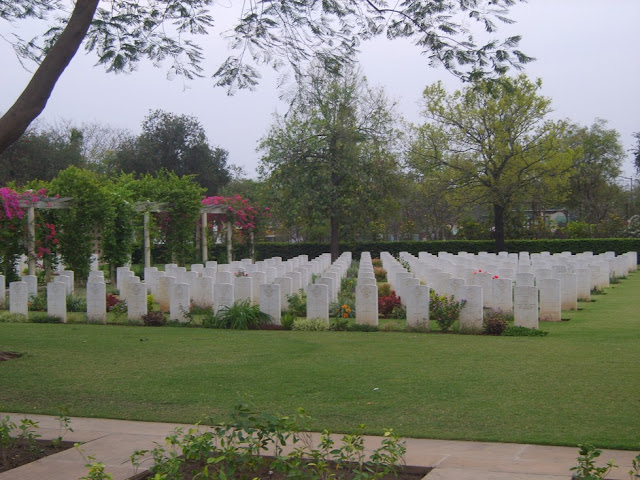
Delhi War Cemetery at Dhaula Kuan

Known Yet Unknown

Known Yet Unknown
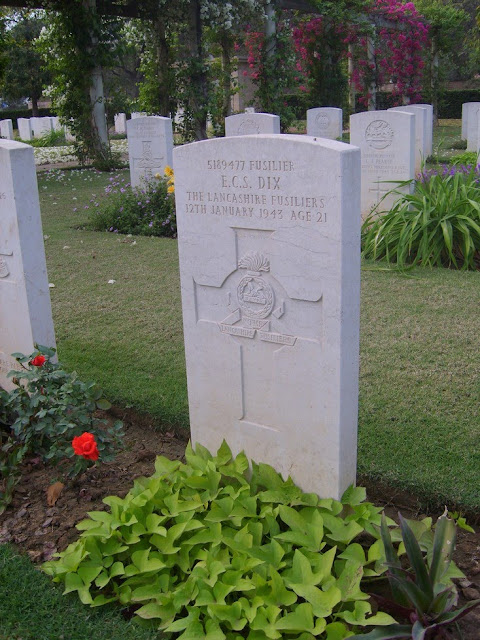
Gravestone of Fusilier E.C.S. Dix from the Delhi War Cemetery

Wednesday, June 28, 2017

DANGERS OF A ONE-WAY MIND

“Those who fail to learn from history are doomed to repeat it.” This was the opinion of British leader and prime minister of wartime Britain Winston Churchill. Diehard imperialist though he was, to me it seems that there was much in what he said. Powerful men and women try to take advantage of the shortness of human memory to manipulate common people. These days there is talk of ‘The Emergency’ for it was in the month of June that this dictatorial patch marred Indian democracy. I am sure those born after 1965 would not remember much about it. But I think this is an appropriate time to recall an essay written in 1934 by Wilfred Wellock, a British Labour Party leader, peace activist and Member of Parliament. Following is the essay which appeared under the title ‘Military And Fascist Madness Or The Peril of The One-Way Mind’:

Governments are blundering towards another war, and Fascism threatens to engulf the greater part of the world. The former would appear to be the victims of forces they are unable to control.
No one imagines that responsible statesmen want another war, but their mentality is so antiquated that they are unable to resist the influences which are making for war.
Behind the powerful statesmen are certain groups of very powerful people, most of whom, unfortunately, possess one-way minds. It is they who are doing the damage. Among them are the military castes, and profiteers or Big Business interests.
The former see things professionally, and are so out of touch with the wider aspects of civilization, so ignorant of its needs and possibilities, that they are the very last people who ought to advise Governments. Yet they exercise an enormous influence on most Governments, our own included.
The primary concern of the business people is to have their works running full speed and to be making handsome profits. They think of armaments apart from war, and try to convince themselves that money spent on armaments is a sound investment and a guarantee of national security. The desire for profits blinds them to the real facts, and thus causes them to be as great a danger to the community as professional military men.
This group, also, exercises an enormous influence upon statesmen, while both groups have great influences with the  Press, and are able to secure an alarming degree of publicity for few politicians are strong enough to combat the combined influence of professional military men, Big Business, and the Press.
The danger arising from this condition – and it is world-wide – can scarcely be overestimated, for even now, by reason of it, most nations – Britain included – are rushing towards their doom.
In other words, we are confronted with the peril of the one-way mind – the mind that is so carried away by self and class interest that it overlooks the wider national and international consequences of its conduct. The one-way is a disease, a species of madness, and ought to be treated as such. But, like most mad men, our modern militarists are not aware of their diseased condition. Although economic, military and psychological conditions have entirely changed within recent years, that fact has no significance for them. Their minds appear to have reached a dead end, and in some cases have slipped back several centuries. Material abundance, for instance, which makes war ridiculous, does not affect their outlook; neither the fact that another war would shake civilization to the foundations.
A peculiarity of madness is that its victims become the slaves of a single idea. Our modern militarists, of both varieties, see in every international event a reason for a bigger air force or a larger navy. They will refuse an extra loaf of bread to the industrial outcast, but provide a million bombs with the greatest pleasure. They will scheme like misers to cut down payments to the unemployed, and gloat like demons at the prospect of adding 10,000,000 pounds to the expenditure upon armaments. They are never so happy as when making things to kill people, or getting their countrymen to think about possible enemies and how to destroy them.
Mad men always take themselves seriously, and if by chance they can make others believe in them they can become highly dangerous. Now it so happens that these one-way mind groups are highly place socially, and, as already explained, exercise a considerable influence on affairs. Thus they are able to work up scares and to frighten the public into panic. They are past masters at publicity stage management, and know all the tricks of the trade. They like to play the same role in other countries. Consequently between them they are able to get the peoples of the world intensely afraid of one another, and in the atmosphere thus created to persuade their respective Governments to embark on new armaments programmes. At the end of these mad races all the nations are in the same position relatively as at the beginning, but have the grim satisfaction of knowing that if fwar occurred they would kill and be killed at double the former rate. In other words, the casualty lists, or, more per cent more deaths. Moreover this process of expanding armaments takes place in all countries at the expense of the unemployed, of education, working-class housing, etc.
Out of this highly barbaric procedure the unemployed get their mead of excitement, of course, while those responsible for it get their mead of limelight and profit. It is wrong to say that the workers need circuses: what they now need, apparently, is the excitement of witnessing the preparation for the extermination at the rate of, say, a million a minute.
It did seem at one time, however, that certain events would be too much for the one-way battalions. But their madness saw them through. They were bold. And, of course, it takes a mad man to be really consistent. The fact of abundance has upset most people, but not the militarists, nor the Fascists. A sufficiency of goods and foodstuffs to satisfy the needs of the entire human race obviously reveals the folly of war. Once the people learned the art of distributing abundance, it would be all up with war, and also with profiteering – and incidentally, with class domination. The one-way mind people saw that clearly, so something had to be done. That millions were in want, in this and most other countries did not affect them. They also knew that workers were accustomed to want. Thus they said: “If there is more food than can be sold at a profit, destroy it and produce less, and if there are too many manufactured goods that people can afford to buy, close down the factories.” To them the thing was perfectly simple. True there was a minority of the public who rebelled. But the pure breed specimens of the one-way mind replied: “Don’t we own the engines of publicity? What we say, goes, and what we do is accepted as coming from the gods.  Don’t dilly-dally. Dogs like strong masters, and ignorant people leaders who know.”
So they had their way, and strange as it may seem, it was accepted by the people as the way of salvation.
Still there remained a hard core of opposition which persisted in saying that abundance ought to mean freedom from poverty and war. They declared that no such madness as destroying food which people needed, and closing down factories when the needs of the masses remained unsatisfied, would be tolerated in Russia. The reply of the one-way mind to this criticism was that the Soviet leaders were materialists and infidels. To which was hurled the Scriptural saying: “He that feedeth one of these my little ones...”
Indeed the unbelievers (in war and poverty) refused to keep quiet. And in saying that the fish which they constantly saw being taken out of Billingsgate and dumped into the sea in order to keep up the prices, would  allay the hunger pains of their underfed children, just as the half-frozen men in food queues of New York insisted that they knew better uses for the surplus coffee and sugar that was causing so much trouble to the City, than burning it.
In due course the body of these unbelievers grew out of all knowledge, and in all lands. This fact was accepted as a challenge by the one-way mind, which furiously objected to any tampering with the “foundations of society.” “Civilisation,” it said, “was founded on War, Poverty and Profit, and any attempt to change that basis would have to be met with the treatment it deserved, since it was an attack upon religion and all that was sacred. Without poverty there could be no charity, and without Imperialism how could Christianity triumph over heathenism? That the Irish and the Indians hated Britain for her oppression merely exposed the depth of their ignorance. The fact that Britain was wholly impartial in her dealings with other peoples was proved by the fact that she was willing to sell her armaments to every Government in the world, a fact which insured that no matter what enemy Britain might have, British soldiers could reasonably rely on the armaments which ended their lives being of good British manufacture.” Indeed the one-way mind never despairs, since it is fortified by the belief that it can never be wrong.
It is quite true that the one-way mind got a little restless when the Disarmament Conference refused to come to an end, as it could not understand why the Imperialist Powers did not tell the world quite plainly that it was impossible for big Empires to be maintained without vast  armaments, and thus that disarmament was wholly out of the question. They were rather disquieted at the thought that it has taken the Conference over two years to pluck up the courage to tell the pacifists that there can be no disarmament, and indeed that increased armaments are inevitable.
In another direction the one-way mind is perfectly happy. It is consoled to know that those wretched people who believe in the possibility of abolishing poverty are everywhere being put in their place by Mussolini, Hitler, Dollfuss, Pilsudski, etc. Also it imagines it sees further victories in prospects. It is hoping for victories everywhere – except, perhaps in Russia. Russia is the one fly in the ointment, and it is a very tiresome and threatening fly. It stands for an idea, an idea that persists in spite of defeat and unspeakable persecution. “But,” say the hierarchs of the one-way mind, “wait a little, watch that ring of Fascist Dictatorships around Russia close in and unite, then see!” (In the event, it was the Fascist Dictatorships that bit the dust and Russia or the Soviet Union became a super power. But that was another era and another time).
The Idea has got to be crushed. That is the aim. Immediately after the War (First World War) it seemed that the Idea was going to carry all before it, but it eventually succumbed before the forces in the control of the one-way mind. In the meantime, however, it has gradually spread, and it is today stronger than ever, notwithstanding its defeat in many countries. It must spread if civilization is to be saved from the peril of the one-way mind.
The triumph of Fascism signifies the setting up of something quite new in the world – one-way mind States: States with one political Party, one religion, one philosophy, one newspaper and a one-way mind Dictator at the head of them.
Even God is told to occupy a back seat, since there can be only one Dictator in a State, one person who is infallible...
Freedom, variety, individuality, colour, art, etc., are out of date in the Fascist State; they contradict the demands of the one-way mind, and so must be crushed out, even at the expense of the poor, whose poverty Fascism increases.
When the structure of the Fascist or one-way mind State is complete, we shall have in being the imbecile State: a nation of mad men, every member of which is condemned to be a Ditto. The intellectual economies which such a State can effect are apparent. Since there is only one political theory, one political Party, one economic policy, etc., there is no need for a multiplicity of books, pamphlets and newpapers. Accordingly in Fascist Germany, Italy and Austria thousands of newspapers have ceased publication, while tens of thousands of books and pamphlets have been burned. There is no need to answer arguments in a Fascist State. That simplifies things enormously, and enables the totalitarian State to shine in all its glory. It used to be said of this country that every child born was either a little Liberal or a little Conservative. Since then Socialists and Communists have been added. But in the Fascist State every child born is a Ditto.
In the Fascist or imbecile State the cardinal sin is to wink at the Idea. The seven deadly sins are the seven degrees of intimacy with the Idea. Anyone proved guilty of originating a non-Fascist idea is declared insane and automatically put into a lunatic asylum.
Where this imbecile State does not already exist preparations are being made for its advent. These preparations are being made within the police forces, military forces, and in the Press. The Press is concentrating on the production of the one-way mind by carrying the public from stunt to stunt and so destroying the power of thinking. It converts men and women into racing fans, football fans, cinema fans or what it will. The British public is being led into the one-way mind by means of horse-racing, professional sport and startling divorce suits; the French public by means of sporting events, parliamentary crises and financial scandals; the American public by means of bank frauds, banditry and other forms of sensation outlawry.
The process of making an imbecile State being well under way in many countries, the question now is whether it is possible to make an imbecile world. Imbecility has at last become the condition of the continuation of Capitalism and the maintenance of the privileges for which Capitalism stands. Let the fact be made crystal clear that to defend Capitalism now is to lend a hand, consciously or unconsciously, in establishing the greatest monstrosity in the history of civilization – a Fascist State – and eventually an imbecile world.

Though written more than 80 years back about a situation that arose in the world between the two world wars, many of the things mentioned in it sound alarmingly familiar. Maybe the Fascists succeed even though they lost the war and we are already members of an imbecile world with one-way minds!!!

Sunday, May 7, 2017

ARE INDIANS FIT TO BE CITIZENS?

The British, it seems were right after all when they answered demands for freedom by saying that Indians were incapable of running responsible self government. A few energetic upper class individuals, who had come in direct touch with the West, were convinced that given a chance Indians could run a government much better than imperial British bureaucrats-cum-autocrats. But how wrong they were. That many of them are vilified today particularly by the younger generation is a sign that their confidence in Indians was misplaced. Running a democratic government means a great deal of voluntary organisation and action, an idea which is foreign to most Indians. ‘Let George do it’ predominates their mindset in which ‘George’ can be substituted by the word government. ‘Mai baap sarkar’ is the feeling that rules the minds whether urban or rural.

WE NEED SUPERMEN

The only explanation I have found for the so-called ‘Modi wave’ (which incidentally could fetch no more than 31 per cent support of the voters in 2014) is that people expect him to single-handedly sweep away with a broom the dirt that they have created over the years while they themselves relax. Swachh Bharat, for example is a wonderful idea except that attitudes don’t change overnight even if the Prime Minister wants it to happen. His intention no doubt is laudable. But it is likely to end in total failure since individually people not only have unimaginably dirty habits but also are highly resistant to change.  So who is to convince the man who spits out the paan masaala on the road or shamelessly urinates by the wayside to change his ways?

Some years back in the older parts of the desert town of Jaisalmer (Rajasthan) I had attempted to persuade a shopkeeper, selling spices and tea leaves spread out on a board set up right across an open sewer, to have the place cleaned so that tourists were not turned off. This perfectly sane advice offended him very much and he curtly snapped at me that it was the job of the municipality to keep the area clean, not his. Open sewers leave tourists little option but to block their nostrils with bandanas when taking the famed haveli (old mansions) walks of Bikaner. Inhabitants of the area see nothing odd or shameful in this or even that it might inconvenience people. So when will India become clean? Only when people understand the importance of good hygiene and change their habits voluntarily. It is futile to expect slogans and celebrity endorsements to act like a magic wand. The same goes for dirty money.

THE BIG QUESTION...

The big question is do Indians have the capacity for voluntary action and organisation? The short answer is NO. Their social and family systems make sure that they never develop this capacity. In this connection I want to share an unusually sharp insight into the Indian character. “Europeans”, says the author of an article written over 80 years ago in ‘The Modern Review’, “(and not infrequently Indians themselves) are often taken aback by the fact that the latter exhibit a lamentable lack of organizing power. Among all peoples, they say, those of this country should excel in this respect, for their family and social life is perhaps the best disciplined in the world.” The author of the article Frank C. Bancroft Jr., whose details I have not been able to unearth. He observes that both in the family and in the caste system hierarchies are clear and strictly followed both by those who command and those who obey. This discipline has merely to be transferred to voluntary organisations like political parties or municipal bodies or educational institutions for their efficient functioning.

...AND THE REALITY

But what is the reality? Indians are totally inept at the individual level when it comes to organisation for voluntary work. The reason behind this is that the traditional Indian family is a “benevolent despotism” in which each member performs certain duties but is seldom called upon to exercise the disciplined initiative which is at the heart of voluntary corporate enterprise. “During his youth he does what he is told; in his maturity he does the telling and others obey. Between these two periods there is nothing.” Youngsters are spoon-fed from school and through college and university. They are discouraged from taking initiative or taking their own decisions for fear that they may turn into agitators and challenge the existing powers. Young men and women then marry in accordance with the wishes of their parents and follow the dictates of the head of the family. It is rarely before the age of 45 that a man is forced to take his own decisions either because his predecessor is too old and enfeebled or dead. At this stage of life he is totally unfit to take up the new challenge as he has never learnt how to carry out the role of independent decision making.

What holds true within the family also applies when these kind of people become part of a voluntary social or political organisation. Let’s take the example of a new political party Aam Aadmi Party (AAP). Before being elected to power the party had stated in its vision document that it wants to put the power of governance and the rights of democracy in the hands of the people. This is a clear statement of voluntary organisation and action. People voted overwhelmingly for the party returning 67 of its members to the Delhi assembly two years back. Now a large number of people appear to be disappointed. The party has done nothing for us, they lament. Maybe they got misled by the broom symbol of the party thinking that this party would clean up everything with the broom. Had it not ridden in on the anti-corruption wave? But did not the party say that it wanted to put power in the hands of the people? And if power is in the hands of the people they themselves are expected to exercise it and assert their democratic rights through voluntary organisation and action. But unfortunately Indians are simply incapable of doing this. They want somebody like Narendra Modi or Arvind Kejriwal to do their dirty work for them which I think is a totally unfair expectation.  

JUGGERNAUT OF CHANGE

At the time of independence many had believed that with rise in education people would be able to run their democracy better. But I don’t believe it’s only a matter of education. Mindsets have to change and ordinary people will have to dirty their hands. It won’t be easy as they are ranged against powerful interests who have benefitted from the old mindset and desperately don’t want people to actually exercise power. That is why the top priority of many parties and media houses is to somehow stop this entity called AAP though it is merely a fledgling political party in limited pockets. Is it really that great a threat to long-established political parties? Opponents don’t hesitate to mock those who voted for AAP and use words like ‘severe setback’ and ‘wiped out’ liberally expressing wishful thinking. No corruption case has been proved against AAP members yet Congress leaders who looted the country for years are gleefully telling AAP that it has no right to speak against corruption. This from a party whose members have no compunction in hopping to the BJP to protect their personal interests, ideology be blowed. But beware. The juggernaut of people’s power is on the move and can’t be stopped, not even by the so-called great power of digital media.

Sunday, March 19, 2017

WHERE DID MY VOICE GO?


As the results of the last elections came in I started to get that feeling again – the feeling that I have lost my voice. It has been a feeling that has been coming to me off and on for the past many years. In fact the last time that that I felt that my vote counted was the first time that I voted which was in 1977. The minimum voting age in those years used to be 21. But I was unlucky since when I became 21, Mrs. Indira Gandhi, then prime minister, was still carrying on her cute little experiment with dictatorship. My encounter with democracy as a voter was therefore virtually still born as there were no elections in sight, or so I thought. All of us were convinced that we had seen the last of democratic governance and now were going the way of several young countries of Asia and Africa liberated from empires. 
It has been well said that no one can stop an idea whose time had come. The same could be said of my opportunity to vote which came absolutely without warning when Mrs. Gandhi announced general elections in March, 1977. Now I wonder what made her do it. But at that time it was like light at the end of the dark tunnel. Many of us youngsters had grown tired of the dictatorship practiced during the emergency. There was no respite. Newspapers, that had been censored only sang praises of the government. If you turned on the radio all you would hear about were the good things the prime minister had done - her 20 points to a disciplined India. Her younger son Sanjay was not far behind - even he announced a five-point programme. When it wasn’t about Mrs. Gandhi, the subject was her son and the youth in larger and larger numbers that he led to glory after glory (actually mostly they were goons). One had to be careful about what one said even to one’s neighbours and friends since one could find oneself in jail for some indiscrete critical comment about the government. It was a police state, no less. So when the chance came all of us in the neighbourhood happily marched to the district revenue office and registered ourselves as voters for the first time. We were excited that here at last we seemed to be getting a chance to overthrow the tyrant for that is what Mrs. Gandhi and company had become.

TRYST WITH DICTATORSHIP
Well, our tryst with the dictatorship of the daughter of Pandit Jawaharlal Nehru finally came to an end as our votes booted the Congress out and brought in the newly formed Janata Party. We heard with rapt attention election speeches at the local football ground of people like Babu Jagjivan Ram and Hemvati Nandan Bahuguna who had rebelled against Mrs. Gandhi and were now with the Janata Party. Their powers of oratory then had seemed magical. We were young and impressionable and did not worry too much about whether those we trusted were worthy of that trust. However, about one thing I never entertained a doubt – my vote counted. Indian democracy had a place for my voice. It seemed to me that my vote had helped bring down the mighty government of Mrs. Gandhi (Indira) whose majority in the Lok Sabha was such that she could steamroll any bill or even constitutional amendments that she felt like.
However, as the years passed and I voted in many subsequent elections, both parliamentary and assembly, my faith in the democratic process gradually began to erode and doubts started to creep in about whether my voice counted at all in India’s democratic process. I was told that the votes of people like me who did not vote en masse with my caste or religious group did not really matter. So-called vote banks determined those who would come to power, said those who ‘knew’. And I started to resign myself to the situation as I saw more and more corrupt and unprincipled people getting elected to power and virtually thumbing their noses at the honest and straightforward who felt powerless.

MORAL DECLINE
As a journalist later I had a unique opportunity to watch the political and social process from close and as I began to read about the stalwarts of our freedom movement (not just about Gandhi and Nehru) I discovered that honesty, morality and sincerity did have a place not just in public life but also in private life. I also became rudely aware of the moral decline that had overtaken Indians to such an extent that it has now become commonplace for people to say that idealism was a thing of the past and that in current times to make headway in any sphere one had to be “practical.” This meant that one has to be prepared to tweak principles in order to achieve success, whatever that word means. When I try to be honest, neighbours, friends and relatives call me ‘simple’ when what they really mean is that I am a simpleton or simply stupid. “It’s okay to cheat so long as you don’t get caught,” was one 'homily' that I heard. I was shocked but many others that I know were not. Hadn’t Mrs. Indira Gandhi, daughter of the great Nehru famously asked, “where in the world is there no corruption” when it was pointed out that this was a major failing of India. The floodgates were lifted and we have reached where we are. The ‘magnetic field’ of our morality has been so disturbed that the compass no longer points to ‘true north’. It can be commanded to point in any direction in accordance to our convenience and interest.
But after years of pessimism, I find that there in fact much cause for cheer. Having covered many elections, general as well as assembly over the years, I have come to appreciate that the percentage of votes received by a party is more important than the number of seats that it wins. In India, though the ‘first-past-the-post’ system has resulted in a situation that the voice of the real majority has not received the importance due to it, right from the start. Thanks to the great work of the Election Commission of India (much reviled today on account of the evm machines) statistics on all elections in India since the first elections are available on the web.  Jawaharlal Nehru was among the most popular public figures of his time aside from Mahatma Gandhi. So it was not surprising when he and his party colleague (Masuriyadin) received more than two-thirds of the votes polled in Allahabad (east) cum Jaunpur (west) in Uttar Pradesh in 1952. In the recent elections, incidentally, only 660 people voted for the Congress candidate from the same constituency.

DISCONNECT OF DEMOCRACY  
But what about the entire nation? The percentage of votes polled was 41.21. So what did the Indian National Congress that led the euphoric campaign for national freedom receive? The numbers say that they got 44.99 per cent of the votes. These votes won them 364 seats in the Lok Sabha out of a total of 489 or about 74 per cent of the seats. About 20 per cent more votes were cast in favour of parties that were part of the national movement. But the fact remains that 35 per cent of the voters who voted did not vote for any of these parties. Who were these voters and what were their ideas? They got very meagre representation and therefore little voice in the first Lok Sabha drowned in the clamour of the 45 plus 20 per cent. A beginning had already been made in the direction of what can be described as a distortion of the ‘general will.’ As the years went by this distortion kept increasing and votes for the so-called progressive parties kept decreasing. The big question is whether we can ignore the voice of a large section of our population and still carry on our democracy? The answer is an emphatic no.
That is perhaps the main reason why former prime minister P.V. Narasimha Rao, who led a minority Congress government, called for consensus, recognising for the first time that the large number of people who voted against a ruling party could not be ignored. Their voice had to be taken into account if governance was to meet the expectations of people. Many people accused Rao of being an agent of the RSS and some rumoured that he was ‘khaki’ beneath his dhoti. But it seems he was talking sense. All voices have to be accommodated if governance is to be smooth. He could implement the ‘tough’ economic reforms only because he made others buy in to the idea. This is evident in the fact that all subsequent governments have continued with the same economic policies.
However, to return to the point, as the years have gone by the ruling coalitions have barely managed to cross the half-way mark in terms of vote share while the maximum that any single party was Rajiv Gandhi in 1984 when the Congress received 49 per cent of the votes. The most that the Congress got under Jawaharlal Nehru was 47.78 per cent in 1957. If we add the share of those parties that were involved in the national movement in some way, they would add up to about 65 per cent in the first elections in 1952. This leaves us with the uncomfortable thought that a large proportion of those who voted were not with those who were fighting for freedom.
In recent years the situation has only worsened. If we look at all the alliances that have ruled India over the past dozen years have had majorities in numbers but not in terms of numbers. The latest has an absolute majority in the Lok Sabha, the first time after a gap of 34 years that a single party has enjoyed this status. But what is worrying is that it has secured only a little more than 31 per cent of the vote share. But this figure will not cross 40 per cent even if we include the vote shares of some regional parties that have allied with the ruling party.  So then who represents the 60 per cent? The blunt answer is NO ONE. We are told that elections are one way to show the general will. But what kind of general will is this that leaves out the wishes of the majority? It is very clear that there is what can be called a disconnect in our democracy because the way in which it ascertains general will is gravely flawed. Unless it is addressed it will leave a disbalance that can only give rise to tension and therefore conflict and instability.
What then is the answer? The answer is to replace the first-past-the-post system with proportional representation. In this nmkkind of elections parties are going to get seats in proportion to the percentage of votes that they win and a majority in the legislature will correspond to a majority of the vote share. According to American non-profit ‘FairVote’, “The basic principles underlying proportional representation elections are that all voters deserve representation and that all political groups in society deserve to be represented in our legislatures in proportion to their strength in the electorate. In other words, everyone should have the right to fair representation.” (http://www.fairvote.org/how_proportional_representation_elections_work).
Do I expect India to switch over to the new system anytime soon? Not really. At the moment the powers that be are dragging their feet over having even a paper trail for voting by electronic voting machines. 

Sunday, May 1, 2016

VISITING A VOLCANO IN ECUADOR


COTOPAXI IN THE DISTANCE


The quake in Ecuador took me back to my recent visit to that country, a very enjoyable one. The capital Quito has three major volcanoes nearby, all of which are tourist destinations. They are part of what is known as the ‘Pacific Ring of Fire’, a group of active volcanoes that is in the shape of a horseshoe and passes from Western coasts of South and North America through the Pacific to Southeast Asia and reaches pretty close to India. In fact the 2004 Tsunami in South Asia in which thousands lost their lives and an entire train was washed away in Sri Lanka, was attributed to an under-sea volcanic eruption off the coast of Indonesia which is on the ‘Ring.’
Ecuador is bang on the Andes mountain chain and the tallest volcano it has is Cotopaxi (20000 feet), currently off-bounds for tourists as signs of activity have been noticed in it since 2015. But this does not take away from the fact that it is a symbol of Ecuador and even finds a place on its flag. A slightly lesser one is Cayambe northeast of Quito and at 19300 feet is the second highest mountain in the Ecuadorian Andes. The third is Pichincha which is very close to Quito. The province is named after this volcano. I went close the top two of them – Pichincha and Cayambe. Pichincha is right next to Quito and can be quickly reached by a Gondola which takes one from about 10,000 feet to 14000 ft. in just a few minutes. Cayambe is a little way off – about 70 kilometres to the northeast – and is a little tougher to reach. Cayambe is the name of the indigenous people who live in the region around the volcano. The small but old town at the base is also known as Cayambe. What follows is an account of the visit to Cayambe volcano or to be exact to the point where the glacier begins which is about 4000 feet below the crater. I was curious to see a volcano since the only one that I know of in India is Jwalamukhi in Himachal Pradesh which I have never visited.
Therefore we (my friend and me) decided to pay a visit to Cayambe and accordingly hired a tourist taxi for the purpose. We started off from our hotel ‘Sol De Quito’ (The soul of Quito) on Alemania Avenue in Quito early on a clear morning in a Hyundai MPV. Accompanied by the driver (a lady in blue jeans and jacket), and the guide we drove through the countryside dotted with green-houses where flowers are grown on a commercial basis (flowers by the way are a major export of Ecuador) stopping only once on the outskirts of Quito to take a picture of Cotopaxi. Then on to Cayambe past one of the several Mitad del Mundos (in Spanish it means middle of the world) strewn across Ecuador. Middle of the world refers to the fact that Ecuador lies on the Equator and even derives its name from it. So Ecuadoreans have woven it into their tourist business, a major foreign currency earner. Incidentally, the US dollar is the local currency of Ecuador, replacing its earlier inflation prone domestic currency. So earning dollars is the very life blood of its economy.  

CAYAMBE VOLCANO FROM AFAR

Since it is clear in the early part of the day, mount Cayambe is visible from many kilometres away. (photo) Its ice covered conical top, typical of a volcanic mountain, rises above the rest of the Andean range majestically. It is in that direction that we are headed and I wonder if, when I get to the top, I will be able to see “the creator smoking” , recalling the sic volcano joke goes. But first we stop for a brief loo break at Cayambe, a small town at 9000 feet and change from the MPV to a Mazda 4X4 mini-truck. Only 4X4 vehicles can easily negotiate the steep climb to nearly 15000 feet up a loose gravel road. As the climb begins the slope is gentle and on both sides there are checkerboard fields and even a hacienda, a Spanish colonial farmhouse. Here and there cattle graze on the grassy slopes. We come across small brick houses with tiled roofs, not unlike the ones in India. All the time the Cayambe top looms over us getting bigger and bigger against the clear deep blue sky as we get nearer.
A CLOSER LOOK AT CAYAMBE
  
Gradually, with increasing altitude, the nature of the vegetation begins to change and trees give way to clumps of long yellow grass while the mountainside is covered with pastures. In the Indian highlands these pastures are known as ‘bugiyals’.  We pass by a group of campers who are winding up and wave us on. Many visitors come to this point in vehicles and trek up the rest of the way. The trek seems to be fairly easy at to start with but the going gets tougher and tougher as one crosses the tree and vegetation line at about 14000 feet. After this one comes across just accidental patches of grass or moss or an occasional bunch of flowers growing on the rocks. 
NEARER THE GLACIERS ON CAYAMBE

As the climb gets steeper our driver shifts to the four-wheel mode and we easily pass up the gravel road which has by now not only become seriously steep but also has somewhat larger loose stones and is deeply rutted in many places. The mini-truck stops at what is called ‘The Refuge’ at 14000 feet which has a washroom. The truck can go no further, 4X4 notwithstanding and we have to trek another 1000 feet upwards to reach the edge of the glaciers, roughly three-quarters of a kilometer away. It is now very cold and biting icy winds force us to cover our head and ears with the hood. We start off on the trail after imbibing some warm water and eating a banana each. Slithering, slipping and panting we trek along the rock wall. Nearby there is a stream from the melting glacier. But the slope there is so loose that it is impossible to walk up or down without technical support. We are now well above the vegetation line. So what to talk of trees, even grass is scarce. A patch of yellow flowers on a rock is the sum total of vegetation at that height. Must be the result of seeds in bird droppings. 
A FLOWER PATCH AT 14500 FEET
        
At the edge of the glacier it is 15000 feet and the ice has formed a tunnel-like structure from which water is dripping and flowing down the mountain-side in a stream. The top surface of the glacier is jagged and in the sunlight the ice is translucent and reflects various shades from snow white and dirty grey to sky blue. Set against the brown volcanic rocks it looks like an abstract painting. This is the highest point on the earth that I have been to in my life, higher than Leh. But even this point is a good four thousand feet below the crater of the volcano which last erupted in 1786. But the height is enough to dwarf the other hills in the distance.
MODERN ART IN ICE BY NATURE AT CAYAMBE-
beginning of the glacier. Another 3000 feet to the crater

Later we returned to Cayambe town for a lunch consisting of steak and eggs before returning to Quito. The trip to the glaciers was good though fairly tough in parts. Wish I could have trekked up the whole way though we did not have the luxury of time. But now among my limited accomplishments I have the satisfaction of having been at 15000 feet if that by itself is something to be pleased about.   
SELF AT 14500 FEET


Monday, April 18, 2016

A CHINESE WHO HELPED INDIA FIND IT’S LOST PAST

Indians take history for granted since perhaps they have a surfeit of it. New Delhi, started as a showpiece of the British Empire, is itself nearing a century. A trip to Delhi University inevitably takes one past the Old Fort and the Red Fort, both hundreds of years old. But rarely does one stop to think about their builders or the role that they played in making the past that brought us where we are now. The sceptic asks, how does the ‘dead past’ matter now? If Shahjahan built the Red Fort, in the 17th century, what of it? Today’s builders (who are in trouble these days due to a slump in realty) are much more relevant to us because we buy and live in the houses that they build. 
My response to those asking this question is: why is Hitler’s holocaust kept alive to this day though more than 70 years have passed since it happened? None of the people who committed the atrocities are alive any more so why not forget and forgive? The Vietnamese say that while they have forgiven they have not forgotten and they keep alive in museums memories of their sufferings of decades ago when they became victims in a clash of ideologies during the Cold War. Why is the anniversary of Second World War, the most destructive war in history is observed every year though a good 70 years have passed since it came to an end? The simple answer is that these events help us to locate ourselves in the present. A quarter of a century has passed has gone by under the looming shadow of economic liberalization and phenomenal growth in India. For those it has touched but slightly it sometimes looks like a curse. But can we understand what’s happening without knowing that the Cold War was a barrier to globalization? And going back a little, can we explain the Cold War without knowing about the Second World War. The single-word answer is ‘NO’.

THE CHINESE PUZZLE


To return to the mystery of the Chinese and India’s lost past, let me begin by saying that much of India’s ‘historical’ as against ‘mythological’ past was discovered and recorded in the 19th and 20th centuries. As civilizations became literate, greater authenticity was attached to written records rather than to oral traditions, a category to which mythology belonged. And Indian mythology embodied in the ‘Puranas’ (or stories of times past) had nothing relating to Lord Buddha and Buddhism though it was later found that he belonged to the sub-continent and his followers occupied a prominent place in Indian culture for more than a 1000 years before mysteriously disappearing from the collective memory. Two men were instrumental in reviving that memory – a seventh century Chinese religious tourist Huen Tsang (Xuanzang according to modern phonetics) and many hundred years later by General Alexander Cunningham, a British army man with an interest in archaeology.
How did this happen? To start with how do we know that the Buddha was a virtually forgotten figure in India? Well, there is a painting of the Mahabodhi Temple made by a British official in 1799 with the caption ‘East View of Hindu Temple at Bode Gya’. The painting shows a dilapidated temple with some stone idols with some Hindu worshippers of Lord Vishnu (the preserver) and the Brahma Pipal that devotees believed had been planted by Brahma (the creator). This has been mentioned by a modern Chinese scholar Sun Shuyun in her book ‘Ten Thousand Miles Without a Cloud – An epic journey – One woman’s search for her roots’ published in 2003. It is Sun’s account of her 1999 travel in which retraced the 25000-km journey of Xuanzang (Huen Tsang) who travelled through China, central Asia and India over an 18-year period. It is interesting to note that the name of the town mentioned in the caption of the painting was Bodh Gaya, an obvious reference to the Buddha though well before this he had been installed in the Hindu pantheon as an incarnation of Vishnu.
However, doubts arose in the minds of a number of people including the British who had gathered from accounts of many people from countries where Buddhism was a major religion that the birthplace, enlightenment and death of the Buddha was in the Indian subcontinent. The crucial turning point came around the middle of the 19th century when travelogues of the Chinese pilgrims became available in the English language. Cunningham for example took the help of the record of Xuanzang (Huen Tsang) whose writings went under the title ‘Record of the Western Regions.” From the descriptions of Xuanzang the British archaeologist could conclude that the Brahm Pipal tree at Bodh Gaya was the one under which the Buddha attained enlightenment while the Mahabodhi temple at Bodh Gaya was not a Vishnu temple but was the one built by a king called Ashok to commemorate that event about three centuries later.  

KASHIPUR

A view of the remains of the Panchayatna temple, Kashipur

Here I must reveal that what led me to Xuanzang (Huen Tsang) and Cunningham was a recent visit to Kashipur in the foothills of the Himalayas near Corbett Park. Kashipur is a typical small town whose claim to fame is of recent origin. For one thing a little more than a decade back it was earmarked as an industrial zone by the newly formed state of Uttarakhand and for the other it has become the site of an Indian Institute of Management (IIM) which was started in 2013. But I found that Kashipur had an even older reason for being famous (much older in fact than even when it acquired its current name) and this was that it was one of the places where Xuanzang (Huen Tsang) stopped during his travel in India. The name of the place (which today is Kashipur) has been given as Govisana in the ‘Record of the Western Regions’. Cunningham zeroed in on the place by following the directions given by the Chinese traveler and even found a mound described by him. Excavation of the mound was carried out well after the death of Cunningham, revealing the remains a 7th century temple complex built during the reign of Harshavardhan whose capital was Kannauj. This complex, known as a Panchayatna temple, is maintained by the Archaeological Survey of India but its existence is not very well known even in Kashipur itself.
However, to conclude, we must thank history for our proud present since two important symbols of our nation – the national flag and the official emblem – contain symbols that originate in Buddhism. They are the wheel in the white strip of the flag which is the Buddhist dhamma chakra and the four sided lion capital of Emperor Ashok which is known as the Ashok pillar and is the official seal of India. And all this thanks to a 7th century Chinese traveler and a 19th century Scotsman. 

Friday, April 8, 2016

LITTLE KNOWN FACTS ABOUT DELHI

Over the next few months I plan to write a series about little known facts of Delhi. As William Dalrymple writes, its a city full of Djinns. And where there are Djinns there are stories. The sum of these stories constitute the heritage of the city inherited by its inhabitants. Happy journey.

Sunday, April 3, 2016

DOES DELHI HAVE SOMETHING TO LEARN FROM QUITO?


A view of Quito with Andes mountains in the backdrop


When I mention the name ‘Quito’ few of my students and friends can tell whether I am talking about a person, place or thing. Many of my younger friends have heard of Ecuador, though, but mostly because of their prominence in football and of course because of Julian Assange, the Swede of the Wikileaks fame who has been given asylum at the Ecuador embassy in London. For the others who may not be quite as sports or leak minded Quito is the capital of Ecuador, a country located in the north-western tip of South America which I had the good fortune of visiting last winter, officially to attend an international conference of academics but in reality just lured by the attraction of a chance to see a Latin American country.
We (my friend, his wife and me) arrived in Quito late in the night on a flight from Atlanta (USA) and it was well past midnight that we were able to complete the airport and visa formalities. We hired a taxi and as we drove in the night the people on the roads and the houses made me feel as if I was home in Delhi. The same haphazard off-white and white buildings with flat concrete roofs and dark windows staring at us through the darkness. When we were close to the hotel where we had booked our stay, the taxi driver wanted to take a turn that we thought was an attempt to fleece us (like taxi and auto drivers often do in Delhi). But later we discovered that the driver was right and we had entered the street to our hotel (Sol De Quito or the ‘Soul of Quito’) driving the wrong way on a one-way-street.
We stayed in Quito for just under ten days but during the entire period I could not but help compare the city with our own capital Delhi. Unlike Delhi which is just 500 feet above sea level, Quito is at an elevation of a good 9000 feet. So when I was planning my trip, I had expected that Quito would be very cold. At comparable heights in the Himalayas in India, (say Harsil near Badrinath) it is much colder even during the summer months. And I was visiting Quito during only the beginning of summer there. But to my surprise I found the weather to be very comfortable even at that height possibly because it was located right on the equator. In fact, the zero degree line is a major selling point for tourism, a big business in Ecuador. If you look at the photograph of the city, you will find that it resembles any large Indian hill town - the same somewhat haphazard arrangement of houses painted in myriad colours.   

Another view of Quito 


A STUDY IN CONTRAST
But coming back to comparing the capital of Ecuador with Delhi, the most noticeable thing is that it is much cleaner. Perhaps we could learn a thing or two from the people of this small South American country who put their best foot forward to welcome tourists, one of their major foreign currency earners. Ecuadorians seem to have learnt the self-discipline of not littering. Unlike Indians they do not consider the whole outdoors as their toilet. So one is not overpowered by the stench of urine at crowded street corners. Clean toilets are provided the city’s main business and shopping areas unlike the ones provided by the municipal authorities that are simply unusable as they are never cleaned. To make matters worse, Delhi’s municipal toilets are covered so that anyone wanting to use them need clothesline clips on their noses. Much like tourists in Bikaner who are forced to tie up their noses with a scarf while going on the heritage walk of havelis (traditional houses of the wealthy) to keep out the stink from open sewers!! Someone said during preparations for the Beijing Olympics that the champion spitters of the world were the Chinese. I think it’s hard to beat pan (betel leaf) chewing Indians who leave no public wall or staircase unscathed from red stains. People sticking their heads out of luxury cars to spew out betel. By contrast, in Quito they paint graffiti on public walls. In fact the BMX tracks on which youngsters perform acrobatic stunts on special bicycles are also covered with spray painted graffiti. (photo attached). For the uninitiated, BMX stands for Bike Motor Cross.


Karol Bagh? No, a middle class neighbourhood in Quito


If some figures are compared the contrast becomes starker. Quito’s population is more than 2.5 million, not small for a town situated among high mountains. While the per capita income or gdp of Ecuador is double that of India (12000 dollars as against 6000 dollars), our country is not only much bigger but has an economy and society with a much larger variety. Petroleum, bananas and cocoa are its major dollar earners in addition to tourism. Many expatriate Ecuadorians also send remittances from the US and Spain. Ecuador has no manufacturing or services sector to speak of. It got out of monster inflation about a decade-and-a-half back by making the US dollar its official currency. But overall the position of Ecuador in the world can be said to be much humbler than that of India in terms of numbers, area and complexity of every nature.


PUBLIC TRANSPORT
The other remarkable feature of Quito is its most efficient public transport system consisting of trolley buses and bus rapid transport, the famous BRT which received an unceremonious kick from Delhi. Like I mentioned before, the people of Ecuador are more disciplined and have better self-control than the people of India. What is more, the staff that manage the bus system are also way more efficient and are not prone to skipping the rules. So the BRT buses only stop at the stops meant for them unlike in India where drivers have no qualms about opening the hydraulic doors to let passengers board buses or alight from them at any old place including traffic lights. Though the car population of Quito is not small, automobiles usually leave the BRT corridors alone for the buses. Not so in Delhi where these corridors are the preferred routes for the VIP minded Indian car drivers who feel that their prestige has been shattered just by waiting their turn in the traffic.
These observations I made by actually using the BRT services in Quito. They are as crowded as in Delhi but in our capital I am really scared to use buses mostly because of the free-for-all that one cannot avoid while boarding even though the vehicle might be completely empty. And of course they are much cheaper than taxis. A dollar will carry you a long way. And let me tell you there is no better way of getting to know a city than by travelling by its public transport. The Delhi metro rail will prove my point. And by the way, to strike a positive note, there is nothing like the Delhi metro in Quito!! But in any case I think Delhi has given up a good thing by discontinuing the BRT.
Quito also has trolley buses which is a cross between a tram and a bus. Simply speaking it is a bus which runs on rubber wheels but is powered by overhead wires. It has a larger carrying capacity since it is two buses joined in the centre which consists of flexible bellows. Such buses are known as articulated buses. 
However, I am convinced that India and particularly Delhi has a lot to learn from Ecuador. And of course, I dare say Indians will find South American countries way more interesting than the United States. And therefore a must visit.          


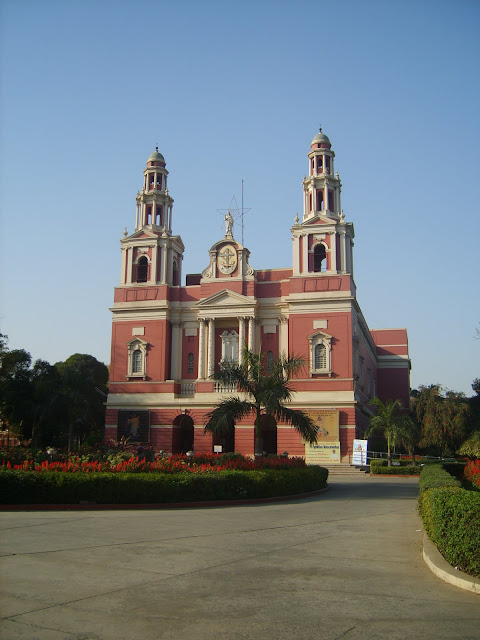
Church at Gol Dak Khana

Church at Gol Dak Khana
serenity amid change