

Originally the term 'Himalayan Miscalculation' was used by Mahatma Gandhi in 1922 when the first Non-cooperation Movement turned violent. In later times 'Himalayan Blunder' was used to refer to the 1962 Indo-Chinese conflict and the mistakes of Jawaharlal Nehru that led to India's humiliating defeat to its northeastern neighbour. However, there are other kinds of blunders that can be committed so far as this mountain range is concerned, blunders that can affect the lives of millions of people. A glance at the story (link below) will show how.
Wednesday, January 11, 2023

Wednesday, January 4, 2023
BANARASI TOMATO ‘CHAT' AND 'ESPRESSO MALAIYO’
 |
| What do you think about Kashi? |
 |
| Nai Sarak |
While tour guides of Varanasi are apologetic about the
rather untidy nature of their city, particularly with respect to European and
American tourists, the fact is that the real charm of the ‘centre of the world’
lies in its crowded alleyways that lead to from the main streets above to the
ghats on the banks of the Ganga below. Some may find the going ‘dirty’ in the
narrow lanes but these are the very lanes and by-lanes around which the culinary
delights of Banaras are available.
 |
| Tomato Chats Served Hot & Spicy |
Out of all the foods available on the
colourful streets of Banaras, four stand out and must-try-out for every visitor.
I will relate them in the order of my preference. The first place goes without
hesitation to ‘tomato chat’. It is available at ‘Deena Chat Bhandar’ on ‘Nai
Sarak’ or the new street of this oldest of the world’s cities. The chat is a
mixture of a number of vegetable ingredients the dominant among which is the
American fruit called tomato. The sting is provided by fine

'Espresso Malaiyo'
ly chopped green
chillies. It is served on a plate of leaves sown together with twigs.

The second
is a milk espresso snack called ‘malaiyo’ which is flavoured and sweetened milk
worked up into a thick froth with a light-yellow colour, filled to the brim of
an earthen tumbler. It resembles the better-known candyfloss. The third delicacy
is the ‘lal peda’ a delicious sweet meat that can be purchased at Rajshree
Sweets in the cantonment area.
The last (not by any means the fourth) is the
Banarasi Paan, or green betel leaf rolled up into a triangular shape and
available virtually anywhere in the city. The best, in my opinion, is the
‘saada’ or plain one, not the sweet paan as the real flavour of the leaf can be
tasted only in a plain paan. A paste of red kattha (catechu powder) and chopped
betel nut is applied on the leaf before it is rolled up and stuffed into the
mouth whole. The combination leaves a characteristic red colour on the inside of
the mouth and red pan stains in corners of stair cases and on walls is a
ubiquitous sight everywhere in India. The real Banarasi paan just melts in the
mouth leaving no fibrous remnants.
Saturday, December 17, 2022
Banaras wisdom: 'Birth Is a Matter of Fate but Death is a Matter of Time'
Chopped wood is stacked up in several neat piles waiting to feed the pyres at Manikarnika Ghat, the cremation ground on the banks of the Ganga in Banaras where the pyres burn day and night. It is a unique cremation ground where the customary Hindu rule of cremating bodies only between sunrise and sunset does not apply. The special blessings of Lord Shiva himself, the lord of the city ensures the liberation of the soul.

Burning Pyres at Manikarnika
As I lean on the railings of the terrace of a temple
at the Ghat in the afternoon watching the flames and smoke rise from at least
half-a-dozen pyres below, I am joined by a Buddhist monk in the characteristic maroon
gown. “Everyone should pay a visit to this place to keep the ego in its right
place,” he opines. He is accompanied by an elderly white lady – maybe European
or American – who too, perhaps has come to Banaras in a search for the meaning
of life – or is it death?

Bereaved waiting for cremation
As I trudge up the narrow alley from the cremation
ground to the main road, the hustle and bustle around continues. Several
funeral processions wind their way down to the ghat chanting ‘Ram naam satya
hai’ (taking the name of Ram is the only truth). The Ganga meanwhile flows
serenely down towards the sea carrying the ashes of the dead.

Words of Wisdom
Not that the belief is universal. I find a sceptic in a
tourist guide and an old-time inhabitant of Banaras. How is it possible, he
asks that ‘moksha’ is assured just by being cremated at Banaras regardless of
merit.
Friday, December 9, 2022
Ganga Cruise
BENARAS CRUISE
Cruising along the Ganga at Banaras is at once a spiritual journey and one that offers the beautiful shimmering reflections of a medley of multi-coloured lights that play in the rippling waters. The Uttar Pradesh Tourism launch M.V. Sam Manekshaw glides softly upstream

Manikarnika cremation ghat of eternal pyres 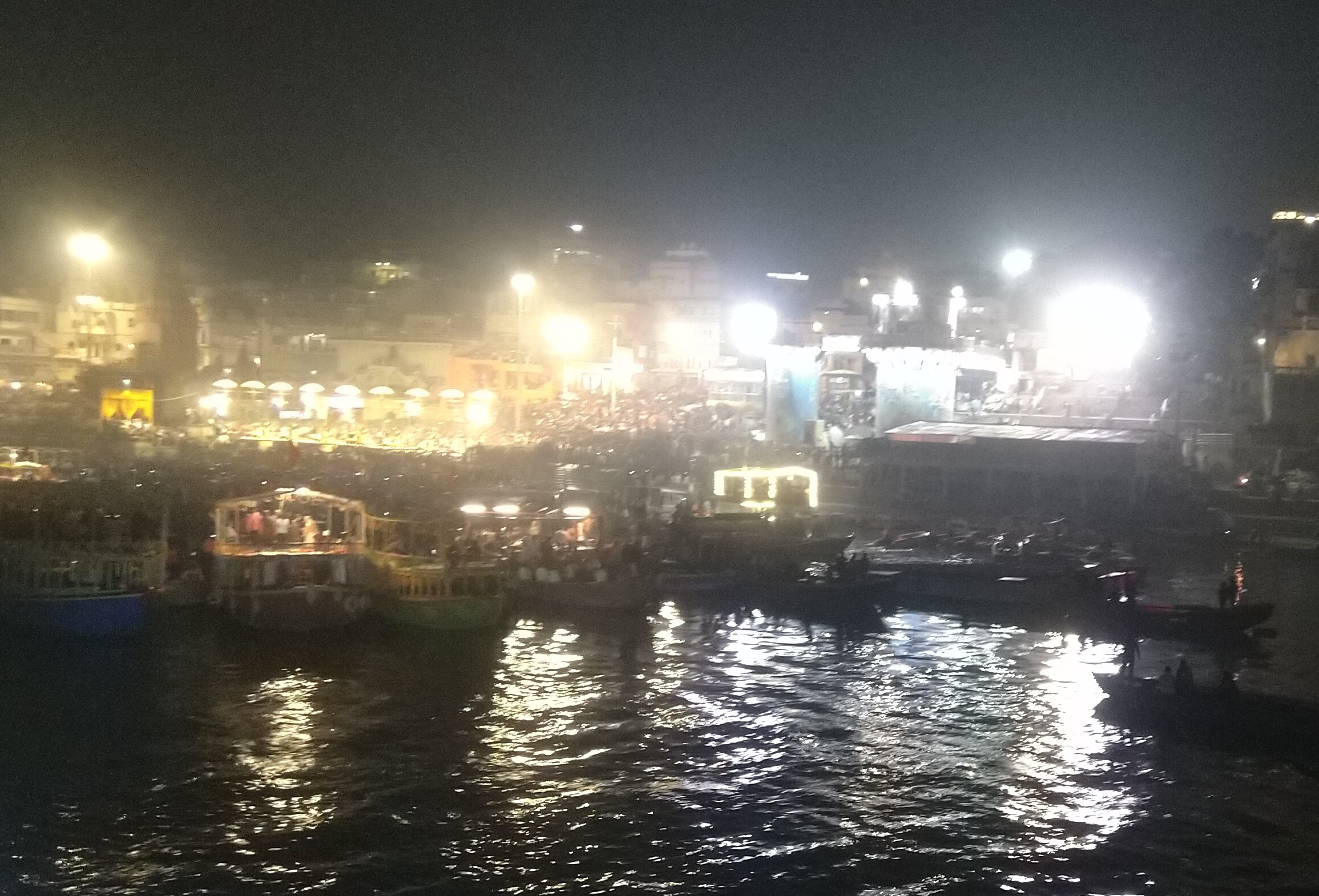
Ganga Arati 
Sunset at Malaviya Bridge
starting from NAMO Ghat, among the latest to the added to the
famed 84 Ghats, sites on the left bank the Ganga for the holy dip and other
religious rituals. The cruise covers all the ghats from Ravidas Ghat to Raj
Ghat and can be booked online at – https://alaknandacruise.com/
The eternal
journey of life (and death) can be viewed from the launch. Vibrating life is
evident in the Ganga Aratis in which the river is worshipped as the source of
life for one of the world’s still living oldest civilizations. Priests blow conch
shells, chant sacred mantras and sing hymns accompanied by bells and swinging huge
brass torches. Thousands gather on the steps surrounding the Ghat or sit in
boats anchored on the river front to watch the proceedings with reverence.
But barely a
hundred yards downstream comes the reminder that life is not all song and dance
and the human journey is a mortal one. This is the Manikarnika Ghat where
cremations are carried out day and night. In fact, legend has it that the pyres
have burned there continuously for centuries without a break. Hindus believe
that though the body is cremated to return it to the elements, the soul attains
‘moksha’ or freedom from all earthly ties if the cremation in carried out in the
Kashi of Vishwanath who helps them along with the ‘Tarak Mantra.’
Saturday, June 25, 2022
In Defence for Nature: The many hurdles of forest dwellers in Uttarakhand - Indian Ruminations
This is a story of the result of arrogance of so-called civilization and the know-alls who refuse to acknowledge that the have-nots may have something from which they can learn.
Friday, March 19, 2021
SNAKE IN THE GRASS
SNAKE IN THE GRASS
 |
| (illustration by Chaitali) |
Snakes perhaps are among the most vilified animals in
the world. Spiders are crawly while lizards are creepy though, except for a few
species, none of them inspire terror like snakes. So much so that they have
even snaked (pun intended) their way into human language in the form of such negative
idioms like ‘snake in the grass’ or ‘forked tongue’. Recently a Bengali
Bollywood and Tollywood star set off a furore when he threatened to strike his
opponents like a cobra.
Among the few writers who have treated these reptiles
with sympathy and understanding is P.G. Wodehouse who has not only included a
benign snake named Peter among characters included in his 1921 novel
‘Indiscretions of Archie’ but has endowed him (indeed PG identifies its gender
too) with emotions that are almost human. Though I may personally hesitate to
go such lengths, from experience I would not hesitate for a second in endorsing
his implied message that at bottom every snake is a good- hearted gentleman,
despite the fact that its heart has only three chambers.
To relate how I arrived at this conclusion I will have
to go back half-a-century in time to Dehra Dun, the place where I grew up and
attended school. My father, a government doctor, had been allotted a residence that
was not only rather big but also had extensive gardens on two sides. Just next
to the compound of the house was a fair-sized orchard of lichee, mango and
jackfruit trees where incidentally I picked up most of my sporting skills. Many
people would sound a caution to me against moving about so freely in that
orchard, some even going to the extent of telling me to beware of a dangerous
‘monster’ that lived there.
Being young and optimistic, I naturally viewed these
warnings sceptically imagining that they cynically wanted to prevent me from
enjoying myself. But after many years of running around in that orchard I had
an encounter with the ‘monster’ in person. The warnings had not been without
foundation. Let me assure you that it was not a terrifying experience though it
was definitely a startling one – both for me and the ‘monster’. The encounter
revealed to me an unknown but very attractive side of the much-suspected wilds
which inspire in most of us that feeling known as ‘unnamed fear’, usually
associated with disembodied spirits.
The ’monster’ in question was a rather large and black
king cobra. My mother had passed away and I was attending university in Delhi.
As a result, there was no one to frequent the garden around our house – for the
sun in the winters and the gentle breeze in the evenings. Taking advantage of
the absence of the “human nuisance” the cobra would come to the concrete walk
next to the veranda to sun himself (or herself, it’s difficult to tell). But it
made off as soon as it heard my steps on the veranda. In a jiffy it had crossed
the 20 feet or so of the garden and disappeared into the undergrowth of the
orchard. A second time I only some days later I only heard the rasping noise as
the snake hurried off, this time in another direction along the concrete walk.
For
me it was a revelation. Hitherto I had regarded snakes as unpleasant and at
times frightening animals. The hiss of an angry snake can be quite ferocious
and unnerving. But the one that I encountered had been living in close
proximity to us and we had never come to know. We went about our business and
it went about its business. Though we made no special efforts to keep out of
its way, the king cobra certainly went out of the way to keep out of the way!!
Since then, my conviction has grown that animals are by and large harmless and it
us humans who are guilty of spreading the greatest harm by wantonly killing all
kinds of animals and insects without any provocation. Besides, our existence is
vitally depended on the birds, animals, plants and trees around us. Without
them we as a species are doomed.
Saturday, October 17, 2020
HAS ARTIFICIAL INTELLIGENCE CHECKMATED HUMANITY?
DIGITAL INTRUSION?
Last
June I posted an entry titled ‘Google As Pied Piper’. That chronicled an
experience with Google maps that I found to be not only alarmingly but intrusive
to the point of being definitely dangerous. The good news that time was that we
were able to reach home unmolested. But it could have been anything depending
upon how the so-called algorithms behind Google Maps functioned. However, much
has come into public focus since then and it turns out that large sections of
people all over the world are coming alive to the real danger posed by social
media to the fabric of society. It has been recognised that it poses a clear threat
to democratic processes and that it has played no small role in muzzling the
voices of millions of people across the world. Most recently it has been Facebook
and Chinese apps that have been facing flak. Mark Zuckerberg was summoned by
American congressmen after the Cambridge Analytica uproar over sharing of
personal information. But other bigwigs of the digital world like Amazon,
Facebook and Google were also summoned by the Intelligence Committee of the
American Senate on the apprehensions of foreign interference in US elections. Curiously,
neither Alphabet CEO Larry Page or Google chief executive Sundar Pichai
appeared for the hearing, raising suspicions about what they may have had to
hide.
The
Watergate Scandal it may be recalled involved the bugging of the US Democratic
Party headquarters by President Nixon and his Republican boys. So huge was the
Watergate Scandal that it resulted in the unceremonious exit of President
Richard Nixon. The book and the film ‘All the President’s Men’. (Those
interested in knowing more about it could see an interview of Richard Nixon by
Robert Fox, ironically available on the site of another social media giant –
YouTube). Earth shaking events by any standards, considering that in those days
the United States was one of only two super powers in the world. In terms of
economic might, it was the only super power. The ripple effects of a drastic
regime change there was sure to be felt all over the world.
But
the world has changed vastly since those days both in terms of US power and the
value of privacy. Soviet Union, the other Super Power, disintegrated in 1991
apparently leaving the US as the unchallenged power. In terms of technology the
internet has seemingly trapped the entire world in its so-called world-wide net
but instead of a spider there are several giant corporations that have become
the biggest private media companies ever known to man. The older seven or eight
giants have paled into insignificance compared to new companies like Google,
Facebook and Amazon all of which gather enormous amounts of information from
individual human beings who also happen to be their customers. Getting bugged
or spied upon is no big deal any longer, partly of course because of the fact
that few people are actually aware that they are under close surveillance. People
just walk around nonchalantly with such scandals literally in their pockets. I
am of course, referring to the ubiquitous mobile smart phone loaded with
applications or apps and “wonderful” high definition cameras on both surfaces
of the phone which are actually two-way cameras. You use it like an ordinary
camera while images are passed on to the various software operators on the
phone.
And
to top it all, the bugging is even considered to be prestigious if your grossly
overpriced device carries the sign of a moth-eaten apple on it!! Reminds one of
the economics propounded by that Wizkid who helped Obelix market his
practically useless menhirs in Asterix comics. The tragi-comedy of it all is
that most people who use smart phones are not even aware that the wonderful
multi-megapixel cameras with which they click those cute selfies are also used
to spy on their every activity and gather all manner of information. Do you
want an example? Well, my phone informs me every evening ‘ten minutes to home’
just about half-an-hour before the end of work time. No such messages now as I
work from home. Un-nerving, for it rubs it in that my movements are not only
being tracked but also recorded.
Its
laughable to think that not so many years back one of the indicators of development
was the number of phones per thousand of population – the higher, the more
developed. India, of course was way down in the list and dismissed variously as
underdeveloped, least developed or developing, according to taste. After a
great deal of ‘progress’ Indians own an estimated five to six hundred million
phones, roughly one for every 2.5 persons (the .5 possibly referring to
children)? Now it seems virtually impossible to get rid of that instrument
somewhat in the manner of Mary’s little lamb. People responded to Arogya Setu
app with great suspicion and only about a hundred million downloaded it, and a
large number had it forced down upon them. The Orwellian ‘big brother’ seems to
have become a reality.
A
rather startling declaration in this connection was made in recent television
documentary ‘Social Dilemma’ by Tristan Harris, a former Google employee. According
to him, eventually technology is destined to overtake human intelligence and
strengths and replace them. But that is in the future. The tipping point it
seems has already occurred. Technology, he asserts “already exceeds and
overwhelms human weaknesses – and is at the root of polarisation, radicalisation,
outragi-fication and vanityfication…. this is checkmate humanity.” In simple
terms, what Harris is saying is that machines have already crossed a threshold
that will enable them eventually to take over (or overtake) man. Are Harris’s fears
well founded or was he overstating it? Was it just a digital social media
marketing ploy? “Don’t even try…you don’t stand a chance,” most of the
characters seem to be saying in the documentary. Remember, he is a former
Google employee and part of the team that created the behemoth. So it is
surprising that about the only thing that he found objectionable in the whole
Google project was that there was no one thinking of making it less addictive. So
why should, to draw a parallel, a cigarette manufacturer think up ways to make
cigarettes less addictive? Or cocaine cartels seriously working to reduce dependence
on hard drugs? D..n it, their business model works on the human weakness of
addiction.
As
I watched the documentary, I definitely got the impression that most of those
who were interviewed were convinced that technology and social media were
unique events in human history in which machines would simply push human beings
to the second spot. But it also had a participant who pointed out, sensibly in
my view, that humans had successfully negotiated new technology in the past and
would do so in future too. But Harris sounded like he was roughly the first
person, an insider at that, who had noticed this very grave danger though no
one in the entire documentary offers any way out of the apparently inevitable
social dilemma. In fact, I did not see any evidence of analysis of the problem,
always the first step towards dealing with it. But perhaps Harris and his colleagues
would be happy to know that the problem had been recognized and analysed long
back by not an American but by an eastern philosopher - Rabindranath Tagore
(1861-1941). The answer too lay in the analysis. Alas, only if it had been
heeded.
Delivering
a lecture 88 years back, ‘Asia’s Response to the Call of the New Age’, Tagore
accurately diagnosed the problem of Western Civilization. He said that Europe had
made science the vehicle of its greed “hurting the very spirit of science which
is disinterested and high above all clamour of profit-hunting. When excess of
passion in any form becomes the principal motive power in man’s nature then he
is wire-pulled by it like a mechanical doll and is powerless to check its blind
movements even when urged by reason. Such uncontrollable spasms of greed or of
anger, or jealousy or of suspicion are truly materialistic, however intelligent
may be their method and means.” It was not the use of machinery itself that was
responsible for this “degradation”, Tagore said, and identified the cause in
the “spiritual lacunae, in emergence of primitive barbarism in some civilized
form. When a free lunatic hurts himself, then it is not the external freedom
which is the cause of his hurt but lunacy itself, and if he is a skilful one
his danger is all the more fatal.”
The
plot in the Silicon Valley contains all the ingredients mentioned by Tagore and
like a mechanical doll it seems powerless to check its blind movements even
when urged by the reason of the likes of Tristan Harris!!
Subscribe to:
Posts (Atom)
Church at Gol Dak Khana

serenity amid change
